Psychology--Fiction and Fact

A blog for the psychological aspects of writing fiction

  • Home
  • About Ian M. Evans
  • Novels
    • The Last Villa
    • Singing Grass
      • Review of Singing Grass
    • The First Village
      • Kirkus Review of The First village
    • Menace
    • The Eye of Kuruman
    • Forgive Me My Trespasses
  • Short Stories
    • Write About What You Know by Ian M. Evans
    • Sing Free the Winds of Change by Ian M. Evans
    • Disperse the Gloomy Clouds of Night
    • Bombs Gone
  • Clinical Psychology
    • CURRICULUM VITAE: Ian M. Evans
      • #684 (no title)
    • What Training Makes a General Practicing Psychologist Versatile?
    • A breast cancer guide
    • Understanding change as it occurs in psychotherapy
    • How and Why Thoughts Change: Foundations of Cognitive Psychotherapy
      • Review of How and Why Thoughts Change by Howard Paul, PhD ABPP
    • How and Why People Change
    • Warming the Emotional Climate of the Primary School Classroom
    • The Teacher’s Guide to Restorative Classroom Discipline
      • Review of Restorative Discipline books
    • The School Leader’s Guide to Restorative School Discipline
    • Positive, educative approaches to challenging behavior in people with severe disabilities
    • Steering by Matariki and the Southern Cross: Plotting Clinical Psychology’s Course in New Zealand
  • Blog
    • Lux, vita, caritas–a memoir of Johannesburg schooldays at St. John’s College
  • Events
  • Contact

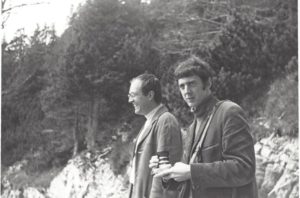
Henry Meurig Nicholas Rees (1927-1999): Welshman, Psychiatrist, Thinker, Mentor, Friend— A Tribute and a Reminiscence

September 20, 2020 By Ian Evans

Henry Meurig Nicholas Rees (1927-1999):
Welshman, Psychiatrist, Thinker, Mentor, Friend—
A Tribute and a Reminiscence

Ian M. Evans , PhD FRSNZ

In the powerful movie Equus (1977), based on Peter Shaffer’s play of the same name, the psychiatrist treating the disturbed teenager is played by Richard Burton. In the movie he is highly introspective and drives a brown Rover. Every time I see the film I’m reminded of Henry Rees, who also was Welsh, drove an identical Rover, and thought deeply about his child patients. Henry loved the puzzle many of the children presented. He once told me that he had originally trained in internal medicine and had been working on treatments for Welsh miners with lung disease. Then a new drug was discovered that essentially cured their illness, rendering his work obsolete. So he thought to himself: What is a medical field where there won’t be any ground-breaking discoveries for a long time? And so he re-trained in child psychiatry!
Henry Rees’s psychiatry training was, I believe, at the Maudsley Hospital (Institute of Psychiatry, King’s College) in London, sometime in the early sixties. There were various brilliant child psychiatrists there at the time, such as Michael Rutter (now Sir Michael) and Lorna Wing, of Asperger syndrome fame. When I met Henry he was the consultant psychiatrist at the Belmont Hospital Children’s Unit, in Sutton, Surrey (South West Metropolitan Region of the NHS). In the UK, consultants typically did “sessions” at various clinical settings, which meant that Henry was only in the Unit one or two days a week. I was there as many days as possible, coming by train from Victoria Station. Sutton was the first stop on the fast train from London to Brighton. Henry arrived by car—the Rover—from his home in Horsham, Sussex, twenty miles to the south. He typically wore a slightly scruffy beige mac, a sportscoat jacket, and wooly-looking ties, smoked a pipe, and had a rosy complexion to his round face and thin nose.
The Children’s Unit had been the brainchild of the hospital Superintendent, Dr. Louis Minski, who had made a name for himself championing the cause of psychiatric patients who were deaf. Recognizing that the challenge of diagnosing and treating deaf patients was further complicated when they were children, he set up a six-bed child unit in 1953. I met Dr. Minski often, as he regularly came down to our meetings to discuss individual cases, along with his Registrar at the time, Dr. Shepperd. He was a down-to-earth, blunt but kindly, old-fashioned doctor, in the image one might expect of a gruff, country physician on a TV drama. He knew from the start that a hospital ward was no place for children. So he moved out of his official Superintendent’s residence on the hospital grounds and turned the house into a short-term residential unit for young children from all over Britain. A couple of years later he persuaded the Nuffield Provincial Hospitals Trust to establish a second facility, and they bought and equipped a large detached, Edwardian family house in the Sutton suburbs, afterwards called the Annexe (Minski & Mary J. Evans, 1961).
Thus, by 1966 the Belmont Hospital Children’s Unit consisted of two family-style homes with about six children in each, staffed by nurses and nursing assistants called housemothers, none wearing uniforms of any kind. The two senior nurses, both young very capable women who shared a flat nearby, were Patricia Evans (no relation) and Rosemary Williamson. In the first house, meals were delivered from the main hospital; in the Annexe there was a full-time cook, who could have come straight from a BBC period drama. There was an austere, well-regarded Educational Psychologist, Dr. Agatha Bowley, who provided the psychometric testing, and a full-time teacher of the deaf, Miss Joan Taylor, who ran the classroom in each unit. There was also a social worker who worked with the parents and families, thereby completing what the great American child psychiatrist Leon Eisenberg once called “the holy trinity”: the medical psychiatrist, the psychologist, and the social worker.
In early autumn 1966, my first year as a doctoral student in psychology at the Maudsley, I was introduced to this rich and complex setting by an experienced Australian clinical psychologist, James Humphery. Some years earlier, Jim had come to London to work on his PhD under Professor Hans J. Eysenck. I had become close friends with another post-graduate student, Rosemery O. Nelson, who was on a one-year visiting Fulbright scholarship from the USA. We were both very keen to gain practical experience in the rapidly advancing field of behavior therapy, and Jim took us out to the Belmont to show us what he had been doing using simple reinforcement procedures with some of the children as part of his doctoral thesis on the outcomes of behavioral treatments. However a problem arose in the presentation of his statistics and he failed to pass the oral exam and returned abruptly to Australia. This left Rosemery and me the inheritors of his program and we gradually adjusted it and made it our own.
Henry was fascinated by the potential benefits of behavior modification. The clinical application of Skinnerian operant conditioning principles represented a new approach in Britain, and both Rosemery and I were well versed in the theory. But it was his broader interest in data and research, and his total commitment to understanding and improving the lives of the young children in the units that allowed me to learn an enormous amount from Henry about every aspect of the mental health of our complex and multiply diagnosed children. Due to an earlier rubella epidemic we had deaf children, as well as children with intellectual disabilities, children with autism, children with developmental aphasia and elective mutism, children with what at the time was referred to as minimal brain damage, and children with emotional disturbance. Most children showed symptoms of more than one such condition. Adding to that complex mix was the fact that a few children came to us from highly deprived family environments: one child’s parents had both been institutionalized with schizophrenia; another child had been tied to a cot all day by his elderly grandmother to “keep him safe” while his parents were away working. Children with severe social withdrawal, and marasmus (failure to thrive), as a result of such extreme physical and emotional deprivation, were the ones who responded most rapidly to the warm, nurturing, family atmosphere of the two houses. Henry often pointed out how different that pattern was from the social “avoidance” of the children with autism, which seemed relatively unresponsive to the positive emotional atmosphere of the two houses..
In the early months Rosemery and I were at the units, Dr. Minski ran the monthly formal case conference discussions. He sat at the head of the table and asked the educational psychologist to present her tests scores. Then he asked the social worker for a summary of the family, and then he wrote up his conclusions and decisions about the child. “Wrote up” is a misnomer. He confidently dictated his clinical report there and then, speaking into a small Dictaphone, while the rest of us sat silently around the table—holy trinity indeed. While I didn’t necessarily disagree with Dr. Minski’s summaries of each case, there was no attempt at a conceptual or psychological analysis. When Henry took over these events, however, his style was completely different. He asked detailed questions, formulated hypotheses, wanted evidence for our assertions, and ended up not so much with a categorical label as a functional description of the child’s needs. For eager younger scholars such as Rosemery and myself interested in behavioral assessment rather than textbook diagnoses (Evans & Nelson, 1974), his approach was the ideal form of good clinical description and analysis. If some degree of certainty around a diagnosis could not be established, it was put on hold until we had more opportunity to observe and to try out little experimental tests to see what the child might do under different circumstances. Henry was in no hurry to plonk down a diagnostic label and he was in no hurry to medicate any of the children unless the nurses reported one of them was physically ill.
On one occasion the staff were concerned that Simon was not eating at mealtimes and efforts to cajole, demand, and threaten him were not working. I suggested a simple operant shaping procedure, starting with a very low demand (“Finish these three peas”), followed by a simple reward (“Good boy! Now you get a scoop of ice-cream”). The criterion behavior was steadily increased, and the reward placed on a partial (intermittent) schedule—always praise but not always a treat afterwards. After some weeks of this program, at one of the group case meetings, Rosemary Williamson, announced with some enthusiasm that “Ian’s plan worked wonders and Simon is now eating normally.” Henry sat up in pretend high dudgeon and said “Nonsense! I solved it. I’ve been giving him a pill that increases appetite!” A classic example of confounded variables in assessing treatment outcomes, and we all laughed and learned together.
Henry fancied himself as an excellent general practitioner. I had a perfectly good GP in Pimlico, central London, where, after a year in London House, I lived in a bed-sit in Warwick Square. To get to see him, however, required a full morning of sitting in the sparse NHS waiting room of his surgery. I preferred to cough and sneeze my way through my train journey and then get wet in the typical rain, walking from Sutton station to the hospital. On arriving as a drowned rat, I would complain to Henry: “I think I’m getting a bit of a sore throat. Maybe I’m coming down with strep or something.”
“Ooh, let’s see boyo. Stick out your tongue and open wide,” Henry would respond.
He’d then dig around in his doctor’s bag for a tongue depressor and a little flashlight he produced from his coat pocket.
“Ah yes, boyo, I see some swell-ing,” he’d say. He’d rustle around in his bag and find a free-sample bottle of pills and carefully read the label:
“Here you go, swallow these. It says take one, but take two, boyo, take two; get it into the blood stream!”
Henry gave Rosemery and me a tremendous degree of free license to design our intervention programs, mostly around the development of spoken language given that a communication deficit was the one common feature of all the children. While there were occasional outbursts of negative tantrums and aggressive behavior, the overall level of challenging behaviors was very low, despite most of the children having one at least comorbid diagnosis of autism. Rosemery and I basically followed Jim Humphery’s program at first, but then added to it by combining our reward and shaping procedures with some ideas from speech therapy (Nelson & Evans, 1968). We were aware of Ivar Lovaas’s work at UCLA because two of his graduate students, Irene Kassorla and Bernie Perloff, had arrived that same year at the Maudsley, with Irene starting a doctorate under Eysenck. But applied behavior analysis was not well known in Britain at the time and we were the only program in the UK applying operant principles with children—the BBC (Midlands) even came to the Unit and made a documentary on what we were doing .
Henry implicitly supported a positive, reward-based approach to behavior modification and so punishment procedures or any other negative interventions simply never arose as a possible intervention strategy. His humanity and caring for the children always took precedence in any treatment decision. He added a strong interest in neurological issues, about which Rosemery and I knew very little. He had simple clinical tricks for establishing cortical dominance, such as handing a child a toy telescope and observing which eye he or she put it up to. And he was an acute observer of what are sometimes called “soft neurological signs,” which helped us to be more observant of the children’s idiosyncrasies. He was fascinated by repetitive motor mannerisms (stereotypies) as well as echolalia, and was the first clinician I had encountered who suggested the core difficulty for autistic children was, in his words, “They have a perceptual problem, a sensory problem; they don’t experience the world the same way we do.” He had a delightful way of confronting the issue of whether autism could be considered a true syndrome in nature: “It’s like the Irishman who is asked about leprechauns. ‘Oh,’ the Irishman would reply, ‘there’s no such thing—they’re about so high’”—holding out his hand to gesture the height of about three feet off the ground!
I think that apart from being a trained physician, Henry’s interest in the children’s neurological problems derived somewhat from his own dysphasia. He would sometime stop in the middle of a conversation, indeed in the middle of a sentence, and pause for quite a long time. Often one could guess what he was about to say, but if you filled it in for him, he found it very disruptive. He explained to me once that in his conscious mind he knew what the next words should be, but he could not express them. He described that while he was in this state of suspended speech, he felt a strong, palpable sensation in his stomach or diaphragm. He did not know why, and he never said anything more to explain his condition, other than openly acknowledging it.
Henry and the staff of the units gave Rosemery and myself an amazing amount of freedom—I shudder when thinking about it. Jim Humphery had set up a little lab in one of the hospital buildings and we walked the kids up there for structured teaching sessions. Later I actually managed to persuade—who exactly?—to let me have one of the bedrooms in the Annexe which I converted into a one-way observation therapy room and where I built an operant-style console for presenting stimuli on a screen from a projector in an adjacent room (Evans, 1970). Without any formal release, the Children’s Unit allowed Rosemery and me to take one of the kids, the afore-mentioned Simon, for a day’s outing. We picked him up on Saturday morning and took him into central London to see the changing of the Queen’s Life Guard at 11.00 am at Horse Guards Parade. There was quite a throng and I lifted Simon up and put him on my shoulders so he could see what was going on. There was a moment of silence while the guards were being inspected and Simon used the opportunity to shout something out, very loudly. As I told the story later, I claimed that the guards all snapped to attention, but that is entirely apocryphal. I doubt they even twitched slightly, but lots of people turned and looked at Simon, unaware that we had spent countless hours teaching him words and were thrilled that he shouted anything at all. We hurried away and bought him an ice-cream. But what in heaven’s name were they thinking letting two first-year graduate students, neither of us British, just take one of the children for an outing without any formal consent process whatsoever? We managed well, I have to say, but not being parents ourselves the one challenge we didn’t anticipate was having to urgently find him a toilet in the heart of London.
While relishing this high level of trust and confidence in me, the feature of my interactions with Henry that I valued the most was the many hours we spent just talking about the children. Autism research was in its infancy at the time, no pun intended. Henry was well-informed on the epidemiological research being carried out by Michael Rutter and his team at the Maudsley, which reported an incidence of early infantile autism (Kanner syndrome) of approximately 1 in 2,000 children. (Compare that figure to contemporary estimates of the prevalence of ASD!) Henry also knew, and once invited to the Unit, Dr. Mildred Creak, the granddame of child psychiatry in Britain. Her “working party” had recently specified nine points, being the criteria for diagnosing autism—although they unwisely called it “childhood schizophrenia” (Creak, 1964). Apart from years of confusion, this eventually resulted in Rutter pointing out how the syndrome bore no resemblance to schizophrenia. Young children with autism often developed neurological problems, such as seizures, in adolescence; they do not end up looking at all like patients with schizophrenia.
Henry was interested in language, particularly echolalia, and the children’s self-stimulation and fascination with spinning or flickering objects. And so we spent many hours observing the children, trying out little mini-experiments, and observing everything such as gait, balance, self-stimulation, lining up rather than imaginative play with toys, finger dexterity, cerebral dominance, aversion to touch, and gaze avoidance. He inspired me to do a small N-of-1 study of Sharon, who after being seemingly mute for a number of months after arrival was very echolalic once she started using words (described in Evans, 1971). Henry often interspersed our stimulating medical discussion with his theoretical ideas and general wisdom about life.
Sometimes these discussions went on so long into the evening that I would miss the last train back to my digs in London. “No matter,” Henry assured me, “you can just come home with me. We’ll have some dinner, and I’ll find you a toothbrush.” So back to his house we’d drive, in the Rover, a terrifying journey as Henry was still engaged in analyzing some issue about one of the children and paying absolutely no attention to the road. When we got to his house it was all dark. Clearly his wife Nansi , a GP in the local area, had gone to bed and there would be a terse note about his dinner being in the warming oven. Of course there was a phone in the units, but it never seemed to occur to Henry to let her know he was running late. Finding me in the house the next morning didn’t please Nansi, but she took it in her stride. She just made me a piece of toast with Marmite, and Henry took me to Horsham Station for a train to Victoria—via Balham and Clapham Junction. I can still hear the guard, in his strong Indian accent, singing out these stops on the line.
At some point in time of the three or more years I spent connected to the Children’s Unit (eventually being formally appointed and paid as a Staff Psychologist from 1968-9), Henry took up a new consultancy. He moved to Birmingham, a large city in the Midlands about a hundred some miles north-west of London, and was employed as a consultant in child psychiatry at the Birmingham Children’s Hospital . I was not privy to his reasons for the move; however I think he felt there were some interesting possibilities allowing a more traditional mental health and family focus to his work. He spent some time telling me how he worried the new residential estates were socially and emotionally disastrous. These estates were rapidly replacing the traditional English working-class attached houses all in a long row down a street. Row houses in deprived areas were being bulldozed in cities like Birmingham in the name of progress, to make way for high-rise towers of modern flats, on large estates that also had some sterile playgrounds and pubs and other ‘amenities’. Henry believed these arrangements were a major cause of family dysfunction, mental illness, and crime. He argued the traditional row house might have only had a tiny back yard, outdoor privy, and washing line, but ensured excellent opportunities to hang over the fence and talk to your neighbors and for the children to go right out onto the street to play. Mothers were totally isolated in high-rise buildings. They were too fearful to let their children leave the flat unaccompanied—the lifts (elevators) were seen as dangerous and the entire area infested with drug use. No-one, he claimed, went to the modern pubs on the estates as they didn’t have the casual run-down atmosphere of the residents’ former local. I think he saw this whole situation as a challenge for a psychiatrist with a social conscience and an understanding of community mental health.
For me personally, and I think for Rosemery Nelson as well, the freedom and intellectual stimulation of an intensive practice setting with good, caring people, was a marvelous learning experience. After a year, Rosemery returned to the US to begin a clinical doctorate at SUNY-Stony Brook, and she later became a highly regarded professor at the University of North Carolina, Greensboro, and one of the most influential cognitive-behavior therapy (CBT) scholars of our generation . After I completed my PhD under Professor Hans Eysenck and Dr. Irene Martin, I took up an Assistant Professorship at the University of Hawai‘i in Honolulu and immediately pursued clinical work with children with autism. That is another story, but it was made possible because of having Henry Rees as a teacher and role-model.
Sadly, I lost track of Pat Evans and Rosemary Williamson when I moved to the US. But there is no doubt that their skill with children with disabilities, their professional competence, astute clinical judgment, and their warmth and humanity and sense of fun is what made the Children’s Unit a special place. The positive emotional climate of the two houses was a direct result of their commitment to their work.
Of course, in retrospect, there were many deficiencies in the services offered at the Children’s Unit, which had begun primarily as a short-term diagnostic service. Subsequent educational opportunities for the children were limited—indeed an official category of intellectual disability at the time in Britain was Ineducable. The power of positive behavior modification allowed such a categorization to be seen as meaningless once applied behaviour analysis surged across America and eventually into Britain. However, the language programs we implemented paid scant attention to natural language acquisition contingencies and generalization, although we did ask everyone on the staff at the units to rehearse and practice communicating with the words we were teaching. What was perhaps most unusual, given contemporary practices, is that the parents and families of these children (living all over the British Isles) had little or no contact with the program and certainly never gave consent to any of the procedures we implemented—including taking their child to London for the changing of the guard. The Unit was proud of how much like a family the setting was, but actual families were nowhere to be seen, nor given support to continue interventions we had established. I don’t know what Henry thought about such matters. He had, somehow, met all or most of the parents, perhaps when the children were first being officially admitted to the Unit, and he had interesting thumb-nail sketches of some of them. One child’s mother, he told us, had “run away with a pastry cook”; another had schizophrenia, a third had had rubella during pregnancy, one father was an alcoholic. Yet the clinical implications of this anecdotal information were rarely explored, although he always commented on the importance of finding out if child had been “wanted”.
As a person, as a doctor, and a scientifically-minded psychiatrist who valued psychology and had little time for psychoanalysis, however, Henry was a magnificent teacher. I became immensely fond of him, perhaps not appreciating that fact until he was there no more, and we had a rather arrogant new consultant psychiatrist who curtly ordered the junior nurse to make him a cup of tea on his arrival. The contrast with Henry was extreme. And while Henry was not a tortured soul like Dr. Martin Dysert, the psychiatrist in Equus, he shared not just Richard Burton’s Welsh accent and a Rover 2000 P6 car, but also his intelligence, thoughtfulness, curiosity, and clinical skill with young people. Henry Rees was an outstandingly warm, genuine, and talented person, totally devoted to the children in his care, and I feel very privileged to have had him as a supervisor and mentor .

References
Creak M. E. A. (1964). Schizophrenic Syndrome in Childhood: Further Progress Report of a Working Party (April 1961). Developmental Medicine and Child Neurology 6, 530–535.

Evans, I. M. (1970). Research [with non-communicating children]. In L. Minski & M. J. Shepperd (Eds.), Non-communicating children. London, UK: Butterworths.

Evans, I. M. (1970). A modular teaching unit for research and therapy with children. Journal of Child Psychology and Psychiatry, 11, 63-67.

Evans, I. M. (1971). Theoretical and experimental aspects of the behaviour modification approach to autistic children. In M. Rutter (Ed.), Infantile autism: Concepts, characteristics, and treatment. London, UK: Churchill.

Evans, I. M., & Nelson, R. O. (1974). A curriculum for the teaching of behavior assessment. American Psychologist, 29, 598-606.

Minski, L., & Evans, M. J. (1961). An analysis of 107 non-communicating children. Journal of Intellectual Disability Research, 5, 77-97.

Nelson, R. O., & Evans, I. M. (1968). The combination of learning principles and speech therapy techniques in the treatment of non-communicating children. Journal of Child Psychology and Psychiatry, 9, 111-124.

Rees, H. N. M., Minski, L., Humphery, J., Bowley, A. H., & Evans, I. M. (1968). Autism in early childhood—an approach toward a rational investigation and therapeutic care. Unpublished manuscript, Belmont Hospital Children’s Unit.

A few photographs I took during my time at the Belmont Hospital Children’s Unit

Henry Rees–A Tribute final version
Pat Evans, in the Annexe backyard Ian Evans Andrew McC Rosemery Nelson, keeping data

Rosemary Williamson The most junior assistant housemother

The cook Sharon has her fingers pushed into her ears
The Whisky Blog , Part 2

September 20, 2020 By Ian Evans

The Whisky Blog: Part 2 .

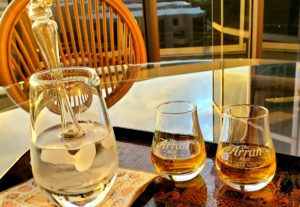
Towards the middle of May, 2020, having run out of single malts—you might say the sun had set on them—we were forced to switch to brandy—temporarily, I assure you. The cognac we had on hand, probably bought originally for making brandy butter at Christmas time, was Courvoisier VS, sort of bottom of the range. But we liked it and decided to go a little more upmarket and try a VSOP. So we went to our very excellent wine shop in Kaimuki, Tamura’s, and with some expert advice selected a middling priced Remy Martin 1738. 1738 was the year that King Louis XV gave a reward for excellence to Mr. Remy Martin. It is rated low on fruitiness, high on smoothness, and medium on opulence and length. Sadly, length doesn’t mean how long the bottle will last during the pandemic but refers to the length of time for which the tastes are expressed after a sip. We enjoyed it. We’ll keep drinking it, but in order to maintain our loyalty to the malt, we did get at the same time three new bottles of proper Scotch whisky.
We’ve now tried all three and have some thoughts. The first we tried was new to us: Kilchoman (more or less pronounced kill-hōman, but if you start the very slightest of gags somewhere between the ‘l’ and the ‘h’, you’ve got it nailed). I’d never heard of this distillery which is understandable as it is really a very new small farm on the most westerly coast of Islay. They have two lines, Machir Bay and the one we bought, Sanaig, “named after a weather-beaten headland, north-west of the distillery”. I must say that I think it quite redundant to describe any headland on the west coast of Islay as ‘weather-beaten’, but there it is. The whisky has spent time (but not much, it is quite young) in Oloroso sherry casks, and an even smaller amount of time in bourbon hogsheads. It has a truly lovely Islay smokiness, but if you detect the claimed flavors of “burnt cocoa (I’ve never had burnt cocoa, so I’m not sure what it tastes like) apples, spice, a touch of cinnamon oil and hazelnuts”, you’re a better person than I am, Gunga Din.
The second one we bought was in memory of many a climb on the Isle of Arran to the isolated little loch called Coire Fhionn Lochan. About halfway up on that walk (when you are neither up nor down), if you stop, turn around, and look west you see for the first time on the other side of the Kintyre coast, two small bumps. These are the tops of the two hills on the Isle of Jura, known rather rudely, as “the paps of Jura”! So that’s why we had to buy a bottle of Jura. The only distillery there has been going since 1810. There is also one pub, one road, and 200 residents. Our malt is called Jura Seven Wood. This is because it has been matured in seven different types of oak barrels: ex-bourbon American white oak, Limousin, Troncais, Allier, Vosges, Jupilles, and Bertranges. Except for the first one, these—as everyone knows—are all different oak tree forests in France, in which the nature of the wood contributes different properties to wine. They then cleverly sell their old used barrels to the 200 residents of Jura. According to the tasting notes, you get hints of ginger, coffee, caramelized peach, chewy liquorice, with just a suggestion of sea spray and smoke in the aftertaste.
Thinking it best to leave the western isles, our third choice was a delightful gentler malt we’ve had before back in New Zealand: Dalwhinnie. The name derives from the Gaelic for ‘meeting place’. Thank god they didn’t actually use the Gaelic word itself: dailcoinneeamh. The distillery is in the central Highlands on a windswept Grampian hilltop. It has a heather-honey sweetness.
After I confidently made such pronouncements, Luanna, thinking I was full of b.s., challenged me to a blind taste test: the brandy and the three whiskies laid out in glasses in random order. The benefit for me, even if proved a fraud, was that I got four drams of spirit that night. Much to her surprise I correctly identified all of them. Some help came from the fact that the brandy is a distinct rich dark color and tastes different as well, the Kilchoman has an intense Islay peaty smokiness, the Dalwhinnie is a mild, sweetish, pre-dinner sipping malt, and the in-between one just had to be Jura!
Needless to say such challenges did result in all four bottles being finished rather quickly. And as the COVID19 restrictions were still in place and more extreme measure were being threatened, late in June 2020 we dashed off to Tamura’s for a new supply. To celebrate our anniversary on June 27, and bot being able to go out to eat, we bought an outrageously expensive cognac, Martell XO, in a fancy bottle that must have been half the cost, but as this is a whisky blog, I’ll say no more about it. And happily at that moment our son Ezell had sent us a bottle of Scapa, which I have described before and may well be our very favorite, not just for its romantic Orkney Isle location, but because it is complex without being overpowered by percentage ABV (‘proof’ in America).
So the three new ones are firstly a different bottle of Kilchoman. We thought we’d give this wee distillery a second chance and try their other offering, Machir Bay, named after Islay’s “most spectacular beach”. Let me assure you that a spectacular beach on the north west (Atlantic) coast of Islay is very different from a spectacular beach on Oahu (Sandwich Islands)—like you can actually swim in one of them. Although proud of the fact that they only use barley grown and malted on their farm on Islay, I have to say this is our least favorite single-malt tried thus far. The claimed “citrus sweetness balanced with tropical fruit” is rather overpowered by peat smoke, iodine, and sea-weed laden sea spay. Maybe they have never tasted the tropical fruit on Oahu!
The next try-out was very successful: Mortlach, sometimes known as “the beast of Dufftown”. Dufftown is a burgh in the Moray region, a little to the east of our relatives in Nairn. This makes it a Speyside whisky, but what makes it a beast, I’m not sure. Maybe its effect on those who drink too much of it? I feel that if you say the word “Mortlach” with a pretend Scottish accent, a well rolled ‘R’ and a good throaty sound to the ‘CH”, often enough, it begins to sound like the name of a monster in Lord of the Rings. The distillery is very proud of the fact that the spirit criss-crosses between six different copper stills that have never been replaced or repaired. The final still, Number Six, is the smallest and is known as ‘The Wee Witchie’. I’ll let you decide why it got this name, but it is useful for confusing Luanna when she asks which single malt are we having tonight, I can reply, mysteriously: “Och, ta’nite, it’s the wee witchy!” It’s a very nice whisky, rich and bold.
Our third new bottle was an old friend. It has long been the favorite of another old friend, Dr John Durocher. We always had to keep a bottle in the house on Beartown Road, Port Crane, NY, and again in Hamilton, New Zealand. What I think he liked about it, and certainly what I like about it, is that you have to call it “THE Macallan.” You may not say, ‘I’ll have a Macallan, please’, or ‘forget the wee witchy, I want a Macallan’. No, it is The Macallan; ours is the 12 years old matured in sherry oak casks. It’s a really smooth drinkable whisky and if one is trying to acquire a taste for single malts it would be a good one to move onto after initiation with Dalwhinnie, which you can just glug down. The Macallan is a rich gold color from the Oloroso sherry casks from Jerez, Spain. It is slightly fruity, spicey, and a classic Scotch whisky, and it’s also from Speyside (i.e., classified as a Highland whisky). Highly recommended.
As all three bottles (four including the Scapa) are now very light, and as the coronavirus shows no signs of departing our fair islands any time soon, we are going to have to pray that Governor Ige and Mayor Caldwell will soon declare Tamura’s an ‘essential service’ and allow it to re-open. Otherwise there will be much sadness in One Waterfront Towers, Kaka’ako.
Ian M. Evans
Honolulu, Hawaii, 9/16/2020

The Paps of Jura Machir Bay, Islay (I think the blue sky has been photoshopped)

Scapa, on a typical day Orkney islander, met a Viking back in the day

The Mystery of Renasay Lodge, Isle of Arran

May 9, 2020 By Ian Evans

Renasay Lodge

Pau hana single malt Scotch whisky diary during the pandemic

May 8, 2020 By Ian Evans

Diary of the sunset pau hana (end of day) wee dram ritual on our lanai during the corona-avoiding self-isolation:


It’s early March, 2020, and Hawaii is in lockdown, so we’ve started with a top-of-the-line 16-year-old Lagavulin from Islay. Finished that. Then moved on to a special edition of Highland Park, Orkneyringa, that we brought back from the Orkney Islands in 2018. We’d been saving it, but it wasn’t totally full and needed to be finished. Then moved on to an Ardbeg Uigeadail—it was half empty, but we’ve got another bottle. Finished that. Decided it was time to move Speyside and we were looking forward to The Macallan, a classic single malt for easy drinking. Alas the bottle, even though still in its fine but deceptive box, was empty. Squeezed out one dram to share. Finished that. Had to start on a new bottle: Glenmorangie, to see what “the sixteen men of Tain” on the banks of the Dornoch Firth had to offer us. We visited the distillery in 2018 after staying with cousins in Nairn, near Inverness (Tain is 40 miles north of Inverness) and had a guided tour and learned the correct pronunciation, which now makes us experts. Just one dram to match the single dram of The Macallan, so plenty left. It will be an orangey week, for sure. For a spot of variety we’ve just had a dram or two of the Arran Distillery’s special Machrie Moor malt in honor of the parents’ wee but ‘n ben that looked over Machrie Moor and the standing stones. It was a pale and powerful first sip—tomorrow it gets one extra drop of water. Finished the Glenmorangie Original (seriously, it wisnae full when we started), and to save the Arran whisky moved on to the Talisker Dark Storm. Talisker is on Skye, which, according to my late mother, is a much inferior island to the Isle of Arran, and nowadays if you wanted to carry a lad born to be king, you dinna need to go over the sea in a wee bonnie boat. There’s a bridge. However, my mother’s opinions notwithstanding, this was the finest malt we’ve had to date, and the best on this page. “Deep, dark, and rich, matured in selected heavily charred casks to give extra spice and smoke” turned out to be an accurate description. However I’m less convinced by the other statement on its dark and stormy box: “Imagine tasting a mighty storm at sea and you have Talisker Dark Storm, the single malt that takes an intense whisky experience to a new level.” However a phrase at the bottom of the label on the bottle is genius: “MADE BY THE SEA”! Tonight we coaxed two more drams out of the Talisker—I do declare that the angels must have had more than their fair share. Finished that. Time to move on to a 10-year-old Laphroaig and will alternate with what’s left of the Arran malt to contrast the effects of being right on the Atlantic Ocean: Islay, known as the Queen of the Hebrides. Laphroaig is well known here in the US, as it has a romantic Gaelic name that is easy to pronounce, if not spell. Alas, the darn angels have been at this bottle as well—‘tis but two third full, and being a pessimist at heart, this means ‘tis one third empty. However, while it lasts, it is a wonderfully pungent peat smoke flavored whisky. A “heathery perfume from Islay’s streams” is claimed, but we didn’t really get it. Laphroaig means ‘beautiful hollow by the broad bay’—Gaelic sure packs a lot of words into one. Finished that. Only two bottles and the dregs of the Machrie Moor left…then what? Aha, happy days—found a hidden bottle of Tomatin distillery’s Cù Bòcan. Sadly less than a half-bottle, 20CL, which is about ¾ of a cup. We bought it in Scotland, and it was very expensive so we were cheap. It has just a hint of smoke on the nose and citrus on the finish, but both sensations were as ephemeral as Cù Bòcan himself. For those less familiar with Scottish legends, Cù Bòcan is a huge black dog with dense fur who has been terrorizing the villagers of Tomatin for centuries. But when a distillery worker tried to touch him, he dissolved into an inky blue cloud of smoke. And that’s what happened to 20CLs of their very costly single malt. By the way, dogs are a common theme. The Arran whisky featured (notice the past tense) a fierce-looking hound on its label. This, of course, as you would guess, is Bran. Among the standing stones on Machrie Moor is a huge stone with a hole in the middle, which is where the warrior giant Fingal tethered his favorite dog, Bran. Fingal’s warrior skills were limited, as what he mostly did was hurl rocks across the sea to pelt a  giant in Ireland. Somewhat understandably, the Irish giant threw them back, which is why there are these huge stones on Machrie Moor. In case you are wondering, the connection between these facts and single malt whisky is indeed as evanescent as, well, an inky blue cloud of smoke. So, talking of smoke, we move on to the second bottle of Ardbeg. Yes, that is smoke indeed; as one of our Māori friends once remarked, ‘hmm, tastes like hāngi’! We plan to alternate it with the very last bottle of all: Scapa! Scapa will flow, one might say, and it will require a very serious analysis. However, surprise! Removal of the last two bottles from the liquor cabinet revealed a tiny, miniature bottle of The Singleton, 12-year-old. Any single malt that starts with “The” is clearly superior and we must have bought it after a tasting at the distillery in Dufftown (yes, that’s its name, it’s on the River Fiddich, a tributary of the River Spey, near to Nairn), and were too embarrassed to walk out sans a purchase. The bottle, at only 5 CLs, put the wee in ‘a wee dram’, but it was smooth, mellow, with a hint of fruity sweetness—at least what little there was to linger on the palate. And so now we are down to the wire: smokey Ardbeg and Scapa, the Orcadian. The distillery is half a mile south of Highland Park and can thus claim only to be the second most northerly distillery in Scotland, one of those claims where second place needn’t really be mentioned at all, being rather pointless. It is on the shores of Scapa Flow, the historic waterway sheltered by five of the islands. At the end of WW I the German fleet was interned in this natural harbor under the terms of the Armistice, but Admiral Ludwig von Reuter, not trusting the allies, scuttled the entire fleet and 52 ships were sunk. In October 1939, just a couple of weeks after Britain declared war with Germany,  perhaps as revenge, a German submarine slipped past the defenses and torpedoed the British battleship, the HMS Royal Oak, which sank with a loss of 833 officers and men. Although now a popular diving location, it is an eerie spot, not unlike the USS Arizona memorial, with bits of sunken ships sticking up out of the water at odd places. None of this has much to do with the whisky. History in general, however, does. The Romans seemed vaguely aware of the Orkney islands and called them the Orcades, hence the name of our Scapa malt, The Orcadian. Long before the German High Seas Fleet (Hochseeflotte) or the Royal Navy ever anchored in Scapa Flow, the Vikings used it as a major base for raids against Scotland and Norway. The old Norse influence is everywhere, and our bottle is described as skiren, Norse for glittering bright skies. Matured in first-fill American oak casks, the whisky is a rich amber, with a creamy sweetness and hints of citrus and heather—without a doubt our favorite in this long list. We’ve been alternating it with the Ardbeg for beautiful contrast effects (there’s none of that wild west smokiness in the Scapa), but now both are, one might say,  finished. This means we will now follow the Russian tradition and smash our special dram glasses in the fire, if we had one, but first we raise a toast for everyone’s good health and to a speedy end to the COVID-19. And for that, Ardbeg takes the prize: at 54.2% alc/vol (for Americans, 108-proof), and if that don’t kill the virus, nothing will, even a Clorox cocktail.

SLÀINTE MHATH, everyone!


Ian & Luanna

Honolulu, Hawaii , May 10th, 2020

Maudsley Memoir: My Four Years as a Doctoral Student of Hans J. Eysenck, 1966-1970, at the Institute of Psychiatry, King’s College, London

June 11, 2019 By Ian Evans

Maudsley Memoir: My Four Years as a Doctoral Student of Hans J. Eysenck, 1966-1970,

at the Institute of Psychiatry, King’s College, London


Ian M. Evans, PhD FRSNZ

Professor Emeritus, Massey University, Wellington, New Zealand


              In 1965 I was an Honour’s student at the University of the Witwatersrand in Johannesburg, and my research project was on the effects of environmental deprivation on “intelligence”. I reared rats in a deprived environment (total darkness) and tested them in total darkness as well. The test involved speed of conditioning–speed of acquiring an operant lever-press response in a Skinner box. My supervisor was Alma E. Hannon, a Senior Lecturer and a well-known behaviourist, largely of a Hullian rather than a Skinnerian persuasion, but I had made it a point to learn as much as possible about Skinner’s approach to learning theory and to psychology, especially clinical applications. The other senior lecturer in the animal lab was Peter Radloff, who had recently come back from a study leave at University College, London. Peter was quite an academic showman, and when I asked him where I should go to do my PhD, he replied immediately, “Oh the only place in the UK is the Maudsley!”

              So without knowing much else about it, I wrote to Hans Eysenck about the possibility of coming in the late summer of 1966 as one of his doctoral students. He wrote a short note back saying I was welcome to come, but that the British government “in their infinite wisdom, had once again failed to provide sufficient funding to the universities,” and so he had no money available for financial support. Fortunately I was able to obtain a scholarship from the Witwatersrand Council of Education, and furnished with my first class Honours degree in Psychology, I duly showed up at the Maudsley hospital one very wet day early in September, 1966.

              I had spent the summer months traveling alone across Europe, armed only with Arthur Frommer’s wonderful American guide book Europe on Five Dollars a Day. I visited Greece, Turkey, Italy, Switzerland, France, Germany and Holland, and had some wonderful adventures. But when I arrived in London at the height of the “swinging Sixties” I was still a rather naïve, sheltered, South African young man who had just turned 22. I showed up in the morning having caught the bus from my digs, but with no raincoat or umbrella (not essential in South Africa), during a heavy shower of British rain. I stood, liked a drowned rat, in Eysenck’s office and he wisely made no attempt to talk to me. Instead he passed me over to his Administrative Assistant, Russ Willett. The story going around, and I’m not sure how accurate it was, was that Russ had been working on his PhD thesis for 14 years! In any event he looked rather helplessly at my soaked appearance and said, yes, they were expecting me, but he still hadn’t worked out a room or an office for me, could I come back in a month’s time?

              This was an inauspicious start to my academic career, but I bravely checked in to my residence hall, London House (for post-graduate students from Commonwealth and ex-commonwealth countries), opened a bank account at the Midland Bank in Camberwell Green, and set about exploring London as much as I possibly could. A month later I was back at DeCrespigny Park, but being out of sight I was also out of mind, so Russ still had no desk arranged for me. I think feeling a bit guilty at this point, he set me up to share a desk in a small room that had once been a patient room at the hospital, with all the usual paraphernalia of a hospital room except with desks instead of beds dotted around. The desk I shared was with Rosemery (sic) Nelson, who was at the Maudsley for a year on a Fulbright scholarship. Rosemery had graduated from one of the universities in St Louis Missouri with a 4.00 GPA and a strong interest, like me, in clinical behaviour therapy

              The great thing about Rosemery, apart from her being as bewildered as I was about life in London but nevertheless game to experience all it had to offer, was that her father, who worked for GM in Flint Michigan, had bought her a car, an Opel, in Germany and had had it shipped to London for her. Alas it was a manual shift and a left-hand drive, neither of which, when driving on the left in Britain, she could really cope with, so I became her chauffeur and we went everywhere together. We soon became very close and intimate friends, except for actual sexual intercourse, because she, a devout Catholic, was “saving herself for marriage.” Her words.

              Now that I was actually in situ, so to speak, I showed up for my first interview with my PhD supervisor. Hans sat at his desk, flicking a paperclip in his fingers so it span around. This was the famous occasion in which he looked at me and said: “Zee computer is on zee second floor, zee library is on zee third floor…I don’t think there is anything else I have to tell you.” But whereas my letter of offer for admission said I’d first be admitted to the Master’s degree, he quickly told me that he was changing that and enrolling me in the PhD program. This was very helpful, except I had no real idea about what I’d work on. As I remember it, Eysenck had close to a hundred students for whom he was the nominal supervisor, and he didn’t really approach me to ask what I intended to do for the thesis work until a few months later. I rattled off some ideas and he said “You have an embarrassment de riches”—as his French was good but mine was not, I had no idea what he was talking about and he said it again in English after giving me a slightly withering look. Then he gave me the best possible advice: “You can save zee world after you have finished your PhD thesis, right now you need to do something programmatic that we are working on.” He assigned me to work with Irene Martin, a Reader in the department, and together we worked out a possible classical conditioning project for myself. As it happened, Rosemery had also been given some tasks of scoring eyelid conditioning records and had had the scoring template made for her, and I simply took it over. However, neither of us was terribly interested in the lab procedures themselves.

              The reason for our distraction was slightly complicated, but boiled down to this. That year in the Psychology Department, there were a number of overseas visitors. By this stage (late in 1966) the whole operation had moved out of the hospital into the newly built quarters of the Institute of Psychiatry (IoP). There was a major intellectual ferment around behaviour therapy. The American visitors all tended to be operant people. Two of them, Irene Kassorla and Bernie Perloff were recent products of UCLA, where they had worked with Ivor Lovaas on his pioneering work on behaviour modification with autistic children. There were other more advanced post-doctoral pioneers, Jeanne Phillips, Ted Rosenthal, and a student of Lykken’s, all from the US, and Jarg Bergold, from Germany. There were also a number of New Zealand and Canadians there as doctoral students; they were all a good deal older than me, most of them married, and their major goal was to get the PhD within two years and get out. Some of them, like Glenn Wilson stayed on and had distinguished careers, but friends like John Grey (a New Zealander working in Canada), and Peter McClean, a Canadian, were pretty focused (Peter made a name for himself in depression treatment, and sadly died a few years ago—his daughter is also a well-known clinical psychologist). Our little network included Bin Toyama, from Japan, who could speak very little English, and a woman from Poland, who seemed even more lost than Rosemery and myself. It was a veritable United Nations of students and scholars—one of the explanations I was given was that Hans had an affinity for Europeans and Americans because he had been denied a Fellowship in the Royal Society. The British science establishment and jealous UK psychology professors who didn’t like his popular books were thought to be strongly biased against him.

              But the big break for Rosemery and me was that a couple of people had set up some practical behavioural programs in clinical settings. For example, Irene Kassorla was working at Springfield Hospital in Tooting Bec with chronic long-term, very regressed patients and she was shaping behaviour using simple schedules of food reward. She took us out to see her work in her bright red Volkswagen. One day before we set off, she cocked her butt and let out a loud fart, saying “It’s this fucking English milk, it’s not homogenized.” I was totally shocked, both at the language and the flatulence—nothing like that had ever been part of my sheltered life in South Africa with rather proper Scottish parents.

              But the person who took most interest in Rosemery and me was an Australian psychologist who was just finishing his PhD. I can’t remember his name, I’m afraid, maybe Jim something or other, but perhaps it is just as well. He was a lot older—had worked as an experienced clinician in Australia and was a friend of Hans’s—they played tennis together. As part of his doctoral thesis he had set up an operant conditioning program in a Children’s Unit out in Sutton, in Surrey: The Belmont Hospital Children’s Unit. The unit consisted of two houses just outside the hospital grounds in the suburbs—they were residential programmes for children with severe communication disorders, which included autism, developmental aphasia, elective mutism, severe hearing loss (rubella children), and so on. Jim trained us in clinical behaviour modification techniques, briefly, and then a sad thing happened. During his thesis oral defence he lied about getting statistical help from Prof Maxwell, one of the IoP’s biostatisticians. Jim’s stats were flawed, which could be excused, but he claimed in the oral to have had advice from Maxwell, which was not true. He failed the oral and was sent back to Australia in disgrace, without a PhD. The chief psychiatrist for the whole hospital, Dr Minski, had met Rosemery and me and asked us to say on and continue the work—what an incredible opportunity for two first year graduate students.


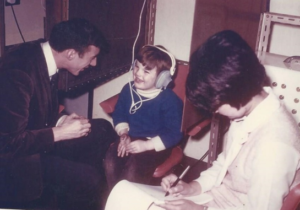
Ian (reinforcing with Smarties) and Rosemery (keeping data) with Andrew at the Children’s Unit, 1967

              Meanwhile I saw next to nothing of my supervisor, Professor Hans J. Eysenck, and very little of my appointed supervisor, Dr Irene Martin. There were no required classes or courses, but we were encouraged to take a statistics course with Dr Patrick “Paddy” Slater. The second lecture was so incomprehensible one of us asked him what he was doing with all his equations on the board. He replied that he was giving the mathematical proof of the analysis of variance. I never went to another class. I did go to seminars in the IoP by visiting speakers, spent a lot of time in the library, wrote a couple of papers for publication on learning theory and on the nature of the relationship in behaviour therapy (Evans & Wilson, 1967; Evans & Wilson, 1968; Wilson, Hannon, & Evans, 1968) and devoted all my other time to the Children’s Unit. At the IoP there were mazing pioneers of behaviour therapy, from both psychiatry (Isaac Marks, Michael Gelder) and from psychology (Stanley “Jack” Rachman, Mike Berger). Jack Rachman had set up a seminar series with another behaviour therapy innovator, Dr Victor Meyer, then working at the Middlesex Hospital, somewhere near Goodge Street. The two of them chaired these fascinating monthly case presentation meetings. But when Rosemery and I volunteered to present our operant work with autistic children, Jack was very dismissive and essentially ignored us, after saying he didn’t know what we would have to contribute! Happily Vic Meyer was much more sympathetic and he eventually invited us to present, which was very positive of him.

              By Christmas of my first year Rosemery and I were a definite item. We went together to one of Hans and Sybil’s “at homes” at their house, as I remember it in Herne Hill. As there was little public transport out there, and we were not yet driving her car, we arrived more than two hours late! In any event we found these events terribly awkward, although their intent was admirable. Hans would sit in a large red leather chair, smiling and saying little, and Sybil would flit around with sandwiches with the crusts cut off, and other finger food. I was always highly anxious I’d drop a cream scone on their nice Persian carpet. The annual departmental Christmas party was also in someone’s home, I can’t remember who’s, and Rosemery came up to me all worried: “Look, the professor is sitting all by himself on the sofa and no-one is talking to him”. “Well”, said I, “you go and talk to him!” So Rosemery went up and sat next to him on the sofa and Hans got up immediately and walked away. There’s introversion for you!

              For someone who was such a strong critic in writing, Hans was amazingly tolerant of fools if they were not challenging his ideas directly. A good example was the infamous Irene Kassorla, who was doing a PhD. She was as thick as a post, and talked utter rubbish. Later she even did an interview on her behaviour modification work for the London Sunday Times in which she said that she had invented behaviour modification and had taught Skinner all that he knew about applied behaviour analysis! Hans simply smiled benignly whenever she opened her mouth and I’m amazed that she got a PhD—the level of science in her work was rock bottom. She later became famous back in California for her book Nice girls do, and later entertainer Merv Griffin dubbed her the “shrink to the stars” due to her celebrity clientele and in the summer of 2015 she leased a furnished vacation spot in Malibu that was listed at $20,000 a month. Maybe Hans saw talent that was totally hidden from the rest of us.

At one of Eysenck’s Tuesday afternoon seminars, when he was commenting about an issue and stated there was no available empirical evidence, I piped up that oh, yes there was such an article recently in the Journal of Consulting and Clinical. In South Africa in our Honours year, Terry Wilson and I were show-offs—we read a lot and we remembered stuff well and used to cite chapter and verse whenever we could. So I made the mistake in this seminar of saying, “Yes, Professor, it was in 1965, Volume 83, pages 29-46.”  Hans perked up right away and asked “What were the findings?” “Oh” said I, “I don’t remember the findings.” There was a long silence while he stared at me and then said icily: “What is the point of knowing about a study if you don’t know zee findings?” I learned a valuable lesson from that moment of shame.

              However these seminars were very informative. For example it was during one such seminar that Hans expounded for the first time on his theory of incubation, talking about the Russian experiment with a dog in which after one or two traumatically aversive conditioning trials the presentation of the CS alone did not result in extinction, but a steadily growing fear CR. It was all very interesting but the clinical examples he gave were not at all convincing—I had been doing a little work with a client who felt nausea and needing to vomit during formal meals. This, plus similar phenomena (writer’s cramp, stage fright, “shy bladder syndrome”), could be much better explained as a fear of fear phenomenon and I wrote a paper on the topic (Evans, 1972), which I still think is a very useful model that fits the clinical phenomena far better, but got very little attention, even after Dianne Chambless started writing formally about fear of fear many years later. The basic incubation theory has been analysed and critiqued numerous time since then, by authors such as Beattie and Corr (2010), Bersh (1980), and Malloy (1990).

              I was also playing with conditioning theories to explain systematic desensitization after Jack Rachman had published articles claiming the effects of SD were not due to extinction but to “counter-conditioning”—I think it was the beginning of his conversion to a more cognitive interpretation of behaviour therapy. I wrote a paper on the topic and submitted it to Behaviour Research and Therapy, but it was rejected. Jack wrote me a note saying that as my paper had criticized his theory, he had sent it to two reviewers and they had both recommended rejection (it was not a tradition of BRAT’s to send the actual reviews back to the authors). Being very inexperienced in the publication game I sent the rejected manuscript to Vic Meyer, whom I really liked, to see if it was worth sending elsewhere. He called me in to talk about it and said he thought it was a good paper but he felt a bit awkward because he had been one of the reviewers for BRAT. I started to apologize for putting him on the spot like that, but he quickly said what concerned him was that he had recommended publication! My faith in the fairness of the editorial process took a bit of a beating that day, but Vic Meyer’s encouragement allowed me to re-submit to another journal where it was accepted (Evans, 1973b).

              Gradually I began to understand some of the issues and politics of the department. I had not realized that the qualification I really should have been enrolled in was the clinical diploma. The academic staff of the diploma course, like Jack, Mike Berger, Monte Shapiro (all South Africans, weirdly enough) were not supportive of students in the more “experimental” PhD program, especially as there was open hostility between Hans and Monte, the director of the clinical course. There were some students doing both the clinical diploma and the PhD—one of them Rosemery and I were friendly with, John Teasdale, who went on to an eminent career in cognitive behaviour therapy at Oxford—he was one of the few people who was about our age. Oddly enough he was also the only English student we encountered in the entire doctoral program. John took us up to Cambridge one time and taught us how to punt. However I don’t think that Jack Rachman was really hostile towards me—it was he who told me that Arthur W. Staats, one of my heroes intellectually, had moved to Hawaii and was setting up a clinical program, and that I should enquire about jobs. Which I did and that is how I ended up in Hawaii.

Basically when you are young and inexperienced you don’t always understand the dynamics of a place where you are not really an insider. I remember one occasion when I was sitting in the tearoom with a group of women, some staff and some students, and I happened to mention how pleasant Sybil Eysenck was. They all turned and stared at me, with daggers in their eyes. Finally one said “That’s because you are male, Ian. She is absolutely horrible to all of us!” Their interpretation was that because Sybil had been a student who had broken up Hans’ first marriage, she was dreadfully afraid that it could happen again, so she kept the young females as far from Hans as possible.

              Rosemery and I went everywhere together—to the Oxford-Cambridge boat race on the Thames, to the theatre, to Speakers’ Corner in Hyde Park, to the ballet, to the Tate. We protested the Vietnam War outside the American embassy, and went to nuclear disarmament rallies in Trafalgar Square, daring movies, strip clubs in Soho, and musicals. We had befriended one of the departmental clerical staff, Valerie, the daughter of a fireman and she took us home for “tea”—a full meal served at 5.00pm. She lived somewhere on Denmark Hill and had a wonderful cockney accent, and hers was the first sort of working class English home we had ever visited. We went to a conference in Southampton, and to the BPS annual conference in Belfast, and drove around Ireland afterwards. Rosemery lived in digs in the East End of London and we went to Chinese restaurants there, as well as a strange pub called Dirty Dick’s that hadn’t been cleaned for 400 years. We went to Hampton Court and to Brighton (our station to get to the Belmont Hospital, Sutton, was the first stop on the London-Brighton railway line). Rosemery re-applied to 12 clinical programs in the US that had rejected her the year before and all 12 offered her admission this time around—the power of the Maudsley name! She selected SUNY Stony Brook because my great South African friend Terrence Wilson was starting his clinical PhD there. When it was time for her to leave we parted at Heathrow, both in tears, and holding hands to the very last minute.


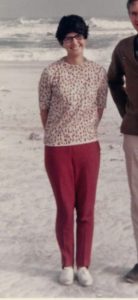
Rosemery O. Nelson in 1967 at Stony Brook

              The following year I did rather play the field. I dated one of the other very young secretaries and we once even had sex in the conditioning lab (nicely soundproofed, no windows, and the doors could be locked). I went out with Hans’s secretary, Tess Maxwell, a few times, usually to the theatre. She was divorced with a couple of young kids and I think it was nice to have a companion to go to plays with. We held hands and kissed a bit on the train rides back to her flat, but nothing more developed, although I think we would both have been happy for it to do so. Tess told me lots of stories about Hans, but they weren’t very scurrilous. She did tell me how he dictated his books and articles to her—walking around his office, twirling his paperclip, while she took it all down in shorthand. She’d then type up the material, he’d correct it, and voilà, a new article, chapter, or book was in the works. Tess also told me funny stories like the time that Sybil had given Hans a very loud tie, which, being an introvert, he didn’t like very much. But he bravely wore it to work, with a nice grey jersey on so that the tie was invisible—Tess came out and told me to try to catch a glimpse of the tie, but I never did.


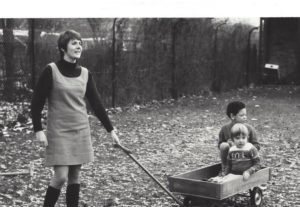
Pat Evans at the Belmont Hospital Children’s Unit

              I also dated one of the nurses at the Children’s Unit at Belmont Hospital, a truly lovely person from the midlands, Coventry, called Pat Evans. She and I went to the movies in Sutton a few times and I stayed over in the flat she shared with another nurse, Rosemary Williamson. By Easter of my second year she was inviting me home to meet her parents. But later that year a young woman I had known in South Africa showed up from Johannesburg and she was the person I eventually proposed to, in the Black Forest in Germany on a trip, and we were married in Caxton Hall, Westminster. Of course, this memoir is supposed to be really more about the Maudsley than about me, but the context is clear—this is why it took me 4 years to get a PhD that everyone else was getting in 2!

              During my second and third years I knuckled down and ran my eyelid conditioning subjects, but I did not analyse the data right away. I was really much more interested in the work I was doing with the autistic children at the Belmont, supervised by a marvelous Welsh consultant psychiatrist called Henry Reese (Nelson & Evans, 1968; Evans, 1970b). And it was a big time for autism because at the Maudsley Michael Rutter was doing important research, as were Lorna Wing, Hermelin and O’Connor, and later Uta Frith—they were all more focused on causal issues whereas I was focused on treatment—the BBC Midlands even came to the Children’s Unit and made a documentary of our work for television. I was getting more involved in that area and actually built a small training device with my own hands and tools that later was published in a journal (Evans, 1970a). And my friend Jarg Bergold managed to arrange for me to give a formal talk on operant conditioning with autistic children to the Max Planck Institute for Psychiatry in Munich, and even Rutter was beginning to notice our work at the Belmont and invited me to present at a conference and to submit a chapter to his new edited book (Evans, 1969; 1971).


Dr Jarg Bergold and Ian in Munich, 1968

All this time I was pretty sure that Hans had no idea at all at what I was doing, and as far as Irene Martin was concerned, she was distracted with other things, specifically her co-researcher, Archie Levey. I would occasionally see Hans in the IoP, often on a Saturday morning if I had come in to work in the library. He often had his young children with him and he watched them run around a play in the corridors and in the elevator, with a sort of benevolent grandfatherly smile on his face. It is so hard to believe today that he must have been only about 52 or 53. I saw him strictly as an elderly person, very remote, and I certainly never really had any sort of conversation with him. But we began to learn some of his foibles, one of which was a sort of professional one-upmanship. A good example was a lecture given in the department by one of Hans’s doctoral students working in a British prison. This student told an interesting story about how the first “token economy”—rewards for good behaviour—was introduced in the Australian penal service by Governors King and Macquarie. You could see Eysenck pricking up his ears. Later we joked that this totally obscure fact would soon emerge elsewhere—and indeed it did, shortly afterwards. When asked to write a review of Alan Kazdin’s major work on the token economy, Hans gave it a positive review but said it was a pity that the author was so ignorant and had neglected the history and origins of token economies in Australia!

The psychology department was large. At 25 years of age everyone was older than me, including the various women that ran the statistical analyses for people or helped with the Facet machines that ran basic stats. I don’t remember their names, except I knew that at least one of them was a New Zealander who loved London and described New Zealand in the most disparaging terms as a cultural desert. I had a little office and on the wall I hung a poster of Picasso’s Blue Nude. In 1968 I met Phil Feldman, then director of clinical training at Birmingham University, and he invited me up to give a series of lectures on the operant approach to modifying children’s behaviour. Funnily enough it was my connection to the Wolpe/Eysenck tradition in behaviour therapy that had appealed to the clinical group in Hawaii, but in London it was my supposed Skinnerian orientation that was getting attention.

I spent a lot of time in Petticoat Lane and Carnaby Street, and took my staid visiting South African school friends to a transvestite bar near the Oval to shock them slightly. The women in the department were fairly trendy and with-it. Sybil wore short skirts and boots; Irene Kassorla wore even shorter skirts, thigh-high white boots and a large feather boa. All of London seemed to be in fancy dress—old military uniform was de rigeur and girls really did walk around in diaphanous dresses with flowers in their hair. I was working more or less full-time at the Belmont Hospital when the formal job offer from Hawaii came through. I was nowhere near finished my thesis and I hadn’t really looked at it for a year. So I quit the Children’s Unit and stayed at home in our rental flat in Pimlico for about 6 months while my new wife taught high school kids in a low-income comprehensive school near Ealing. I worked night and day to finish the data. It had to be run through the University of London’s central computer, and I hired a computer programmer to write the basic program for analysing the voluminous data. Unfortunately he wrote it in COBOL, a machine language, instead of Fortran, which the people at the computer centre understood, so the job often failed to run—and I had so many punch cards that the “CPU” (central processing time) of more than12 minutes meant that the job always had to be run after midnight. It was a very stressful time, and again I got no advice or supervision on this stage of the thesis writing. I do not remember either Irene Martin or Hans Eysenck reading any drafts at all of my thesis before I submitted it to London House. The external examiner was a professor from the University of York, one of Hans’ former students. All I remember is that I could barely talk because I had had my wisdom teeth taken out two days before; but I had heard that if they took out the sherry decanter, you had passed, and I so naturally I peeked through the door before I walked back in. Happily Hans, the professor from York, and the sherry were all there.

              However neglectful or laissez faire the supervision, inspiration was all around me. Probably one of the more remarkable features of Eysenck’s department was his progress chart for doctoral students. Each person’s name was up on the board, and next to it five little coloured squares. The five stages of progress were: 1. Proposal approved, 2. Subjects being run, 3 Data analysis, 4. PhD awarded, 5, Full Professor. There were an amazing number of the fifth coloured squares after many of the names on the board.

              Looking back, I was incredibly lucky to encounter such an intelligent and interested person as Rosemery, to have had supervision from Irene Martin and clinical supervision from a brilliant and dedicated child psychiatrist, Henry Reese. The intellectual atmosphere at the Maudsley was extraordinary and Hans Eysenck created a place where people could find their own way within a strong theoretical and conceptual system, which I greatly valued. I was very interested in theory—learning theory, behaviour theory, and of course Eysenck’s lofty personality theory. There was great excitement over the possibilities of behaviour therapy and the application of scientific research to direct clinical activity. But it was very much a sink or swim environment; I received very little help and guidance, and had it not been for rigorous early training in South Africa, I could easily have failed rather miserably in such an unstructured academic setting. I was very fortunate to find good people to talk to and who supported me and allowed me to do things that a clinical intern would probably rarely have experienced. London itself was a ferment of creativity and youthful revolt, and although I was very poor financially, so much of its richness was freely available.


Publications mentioned from this period:

Evans, I. M., & Wilson, G. T. (1967). Some observations on modern learning theory with special reference to Breger and McGaugh. Psychological Scene, 1, 23-29.

Evans, I., & Wilson, T. (1968). Note on the terminological confusion surrounding systematic desensitization. Psychological Reports, 22, 187-191.

Wilson, G. T., Hannon, A. E., & Evans, I. M. (1968). Behavior therapy and the therapist-patient relationship. Journal of Consulting and Clinical Psychology, 32, 103-109.

Nelson, R. O., & Evans, I. M. (1968). The combination of learning principles and speech therapy techniques in the treatment of non-communicating children. Journal of Child Psychology and Psychiatry, 9, 111-124.

Evans, I. M. (August, 1969). Behaviour therapy with psychotic children. Paper presented at the Second International Congress of Social Psychiatry, London.

.Evans, I. M. (1970a). A modular teaching unit for research and therapy with children. Journal of Child Psychology and Psychiatry, 11, 63-67.

Evans, I. M. (1970b). Research [with non-communicating children]. In L. Minski & M. J. Shepperd (Eds.), Non-communicating children. London, UK: Butterworths.

Evans, I. M. (June, 1970c). Theoretical and experimental aspects of the behaviour modification approach to autistic children. Paper presented at the first CIBA Foundation Study Group on Childhood Autism, London, England.

Evans, I. M. (1971). Theoretical and experimental aspects of the behaviour modification approach to autistic children. In M. Rutter (Ed.), Infantile autism: Concepts, characteristics and treatment. London: Churchill.

Evans, I. M. (1972). A conditioning model of a common neurotic pattern–fear of fear. Psychotherapy: Theory, Research and Practice, 9, 238-241.

Evans, I. M. (1973a). An unusual phenomenon in classical eyelid conditioning: The double conditioned response. South African Journal of Psychology, 3, 83-89.

Evans, I. M. (1973b). The logical requirements for explanations of systematic desensitization. Behavior Therapy, 4, 506-514.


  • 1
  • 2
  • Next Page »

Copyright © 2026 · Ian M. Evans All rights reserved | askmepc-webdesign |